
Mechanical amplifier design, piezostack actuator integration, FEA validation and capacitive-sensor positioning for precision instrumentation.
Overview
Development of precision piezoelectric actuator and mechanical amplification systems for microscopy and high-stability instrumentation applications. The work focused on compact flexure-based amplification, stiffness control, predictable dynamic behaviour, stress management and integration with capacitive sensing for closed-loop positioning.
Engineering Challenge
Piezoelectric stack actuators provide high force and very fine motion control, but their free displacement is limited. The mechanism therefore needed to amplify actuator travel while retaining sufficient stiffness, stability and repeatability. The design also needed to manage local stress concentrations, support predictable dynamic response and fit within a compact precision-instrument envelope.
Engineering Scope
- Designed compact mechanical amplification structures for piezostack actuator systems.
- Developed flexure-based load paths to increase useful travel while maintaining controlled stiffness.
- Used FEA to evaluate stress distribution, compliance and stiffness within the amplification structure.
- Considered dynamic response, mechanical stability and resonance risk for precision operation.
- Supported integration into microscopy and high-stability instrumentation systems with capacitive position sensing.
Mechanical Amplifier CAD
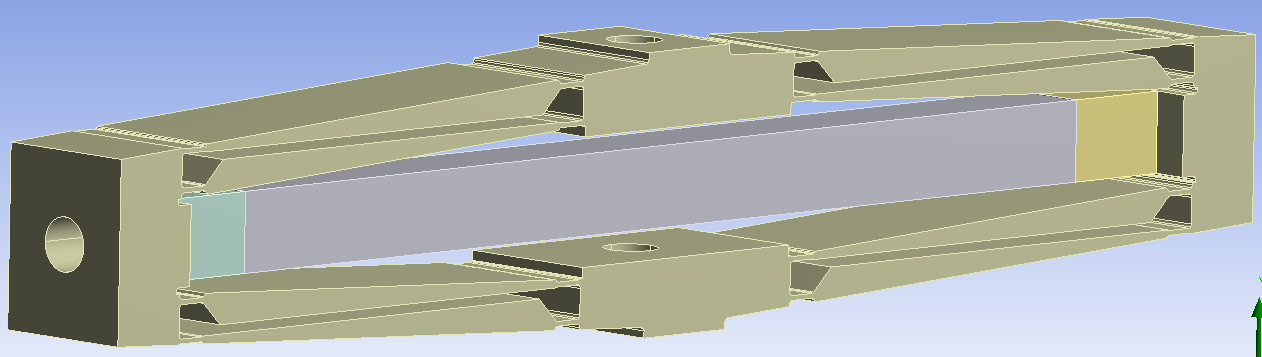
Mechanical amplifier CAD model showing the compact flexure-based structure developed around a piezostack actuator.
FEA and Mechanical Validation
Finite element analysis was used to assess stress levels, compliance and stiffness in the amplification structure. This supported design refinement of the flexure regions and helped balance travel amplification against strength, stiffness and predictable behaviour.

Representative FEA result used to evaluate stress distribution and stiffness behaviour within the mechanical amplifier.
Amplification Principle
The amplifier converted small piezostack displacement into a larger controlled output motion through elastic deformation of the surrounding structure. The concept required careful control of geometry, compliance and load transfer so that amplification could be achieved without excessive stress or loss of positioning stability.
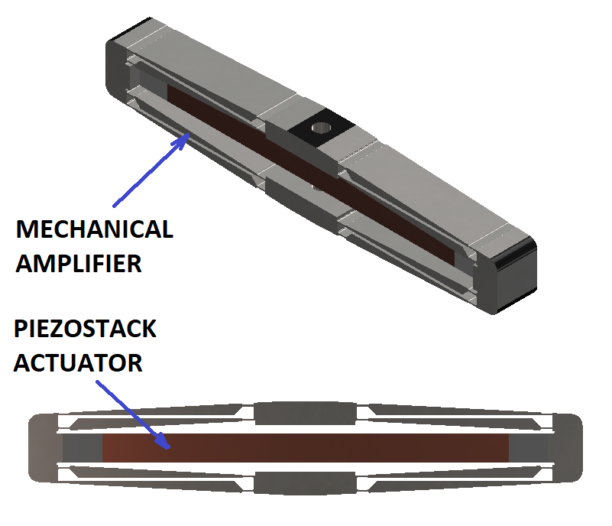
Mechanical amplification principle showing the piezostack actuator and flexure-based mechanical amplifier arrangement.
Microscopy System Context
The actuator and amplification approach was developed for precision microscopy and instrumentation environments where compact packaging, high resolution, high stability and closed-loop position feedback are important system requirements.
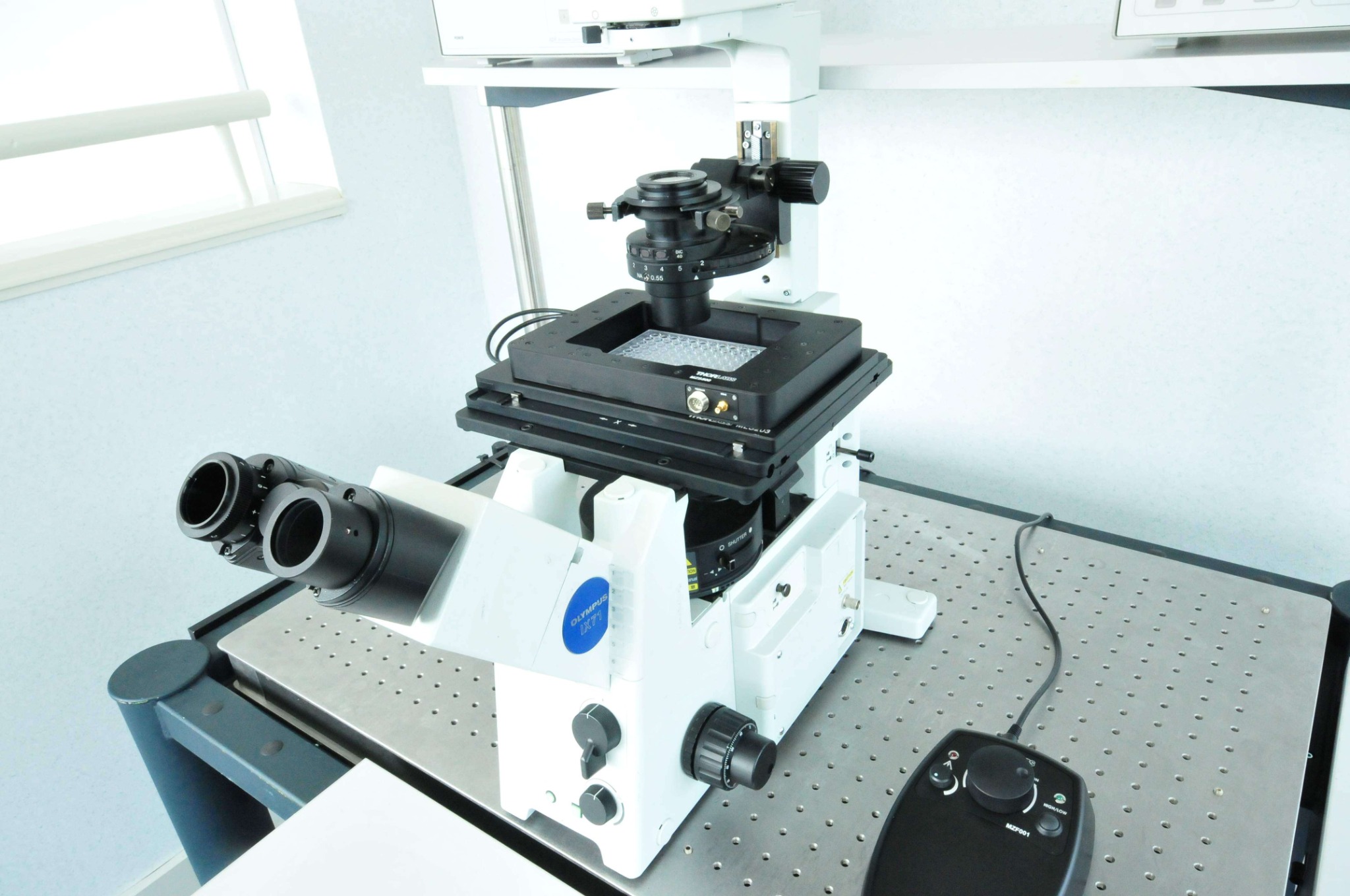
Microscopy system context for high-stability precision positioning applications.
Technical Concept
Mechanical amplification was used to increase actuator travel while maintaining controlled stiffness, stable load paths and acceptable stress levels. Simulation supported optimisation of compliance and stress distribution across the structure. The actuator systems were integrated with capacitive sensing for high-resolution closed-loop position control in precision instrumentation applications.
Outcome
- Developed compact piezoelectric actuator and mechanical amplification concepts for precision positioning.
- Supported precision positioning systems for microscopy and high-stability instrumentation applications.
- Used structural simulation to support stress, compliance and stiffness optimisation.
- Contributed to designs operating in demanding precision-engineering environments.
- Named inventor on patent EP2629930B1.
Confidentiality Note
This case study is described at a high level. No confidential dimensions, detailed calculation inputs, proprietary design data or client-specific internal documentation are disclosed.