
CFD assessment of extraction airflow, internal flow distribution and negative-pressure containment for industrial process equipment.
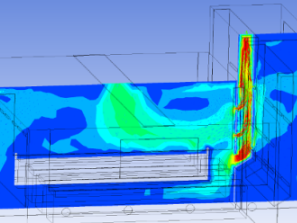
Representative CFD airflow visualisation used to assess extraction effectiveness and containment behaviour within an industrial process cabinet.
Overview
CFD simulation of airflow behaviour within an industrial process cabinet, used to assess extraction effectiveness, internal flow distribution and negative-pressure containment for hazardous process vapour management. The work supported engineering decisions around ventilation path, extraction region placement and containment performance within the cabinet envelope.
Engineering Challenge
The process cabinet required controlled extraction airflow to maintain a slightly negative internal pressure and reduce the risk of hazardous vapour escaping from the machinery. The airflow path needed to be assessed to confirm that vapour and air movement would be directed toward the extraction region, while avoiding stagnant zones, local recirculation or short-circuit flow paths that could compromise containment.
Engineering Scope
- Created a CFD model of the cabinet airflow path and extraction region.
- Evaluated internal velocity distribution, airflow direction and local flow behaviour.
- Assessed whether the extraction arrangement supported negative-pressure containment.
- Identified flow regions that could influence vapour removal effectiveness.
- Supported ventilation and extraction design decisions for safer process equipment operation.
CFD Analysis
The simulation was used to visualise how air moved through the cabinet and toward the extraction region. The results supported assessment of airflow containment behaviour, extraction placement and flow-path effectiveness within the process equipment envelope.
Containment and Extraction Behaviour
The analysis focused on whether the extraction system would encourage air and vapour movement toward the intended outlet while maintaining a negative-pressure bias within the cabinet. This provided a practical engineering check on containment behaviour before relying on physical testing or late-stage design changes.
Outcome
- Demonstrated CFD capability for industrial process airflow and vapour-containment applications.
- Supported evaluation of extraction airflow within a safety-critical process cabinet.
- Provided visual evidence of internal flow behaviour to inform ventilation and extraction design decisions.
- Contributed to safer industrial machinery design by assessing negative-pressure vapour containment at the concept/design stage.
Confidentiality Note
This case study is intentionally described at a high level. No client-specific dimensions, process parameters, flow rates, internal design details or proprietary project documentation are disclosed.